Steve Moss | ACES | Insurtech
Sometimes, the best business ideas don’t start with a grand vision - they begin with a problem that just won’t go away. For Steve Moss, the journey to founding ACES started years ago, deep in the trenches of the insurance industry. Tasked with helping Marsh Insurance manage Vodafone’s mobile insurance program, Steve and his team walked into a challenge: Vodafone was losing nearly $300,000 every month, hamstrung by inefficient claims processes and rampant fraud.
What began as a project to recover value from devices deemed beyond economic repair quickly revealed something bigger. Through hands-on operational analysis, Steve uncovered inefficiencies running through the entire claims lifecycle. Over three years, his team overhauled the operation-streamlining workflows, stamping out fraud, and transforming Vodafone’s program from a financial drain into a $400,000 monthly profit.
This experience was a wake-up call. It showed just how much value could be unlocked with the right systems - and how outdated and fragmented many industry processes had become. Years later, a conversation with a major electronics retailer-“Every return feels like we’re losing more money than we make”-sparked a new realisation: the problem wasn’t isolated. It was systemic, impacting retailers, telcos, and insurers alike.
That’s when the vision for ACES truly took shape. Not as another outsourced claims operation, but as a technology platform built to tackle these challenges at scale-automated, intelligent, and fit for the entire mobile device ecosystem.
Today, ACES is the product of those hard-won lessons. With modern automation, AI, and systemised workflows at its core, ACES is a unified solution that transforms how returns and insurance claims are processed, how policies are sold, and how value is recovered - reducing risk, unlocking efficiency, and delivering measurable impact for everyone involved.
Recently, I was lucky enough to meet Steve at a conference, where he shared some of his thoughts and insights on building ACES and reimagining the future of claims.

What does ACES do? Who is the solution for? What problem does it solve?
ACES (Automated Consumer Electronics Solutions) is an AI-driven ecosystem specifically built for insurers, retailers, and telcos.
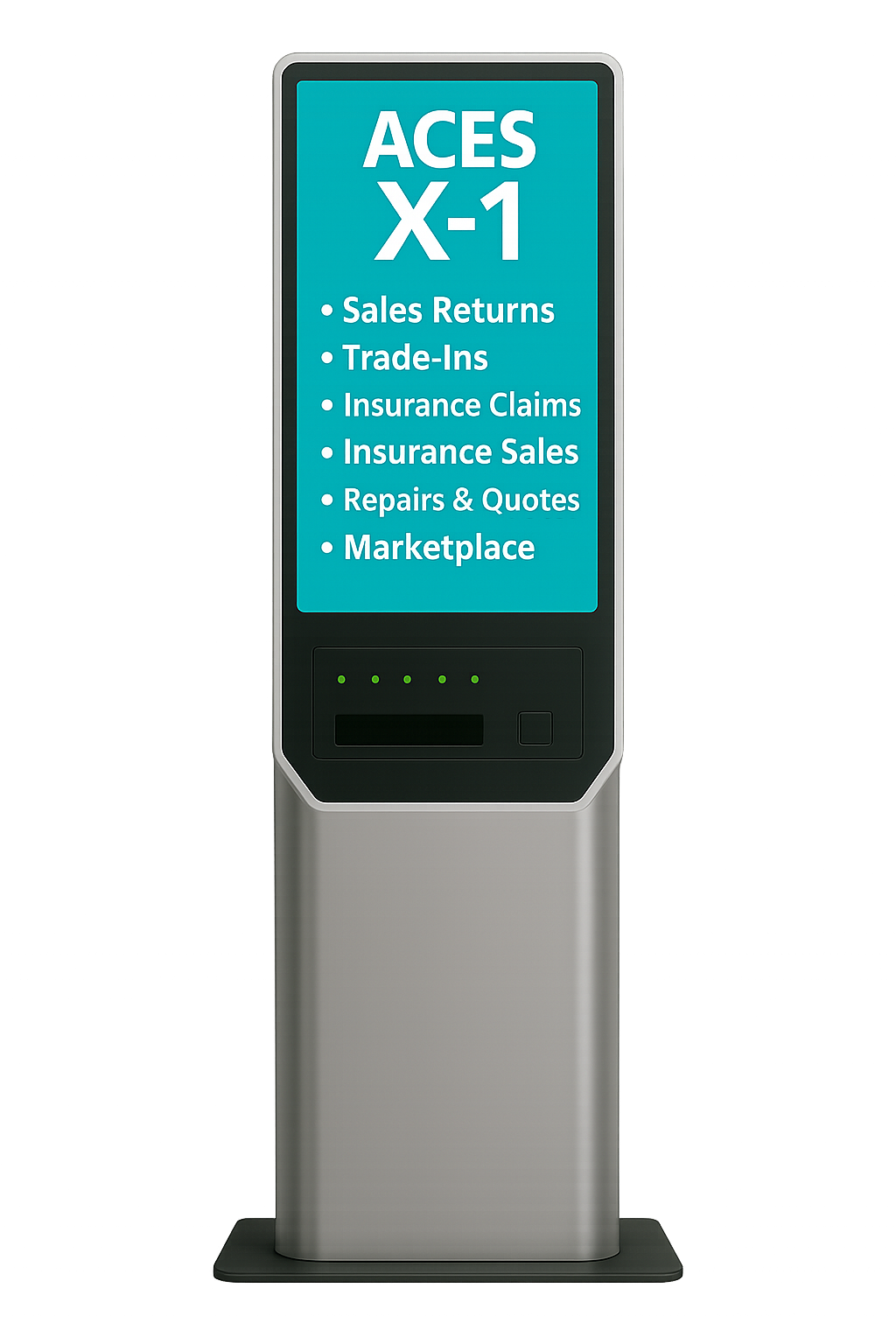
At its heart is the X-One, an intelligent self-service kiosk that replaces manual workflows with automation, enabling on-the-spot assessments and resolutions for insurance claims and returns.
But ACES goes far beyond claims automation. It delivers strategic value across the insurance and retail ecosystem by:
Cutting Claims Costs by over 71% through automation, AI triage, and process optimization.
Reducing Fraud by up to 90% via AI driven claim assessments and verification.
Accelerating Claims Resolution from weeks to minutes with on-the-spot claims processing.
Reducing Repair Costs by 10–30% through AI-driven diagnostics and dynamic, multi-vendor quoting.
Enhancing Customer Satisfaction with faster, transparent and convenient claims experience.
ACES doesn’t just solve operational inefficiencies - it unlocks a smarter, scalable model for insurers and retailers to grow revenue, reduce loss, and deliver better outcomes for customers.
Any key stats, data, reports, or research to give flavour to the opportunity?
The insurance industry is under mounting pressure to reduce costs, combat fraud, meet regulatory requirements, and satisfy rising customer expectations. Yet traditional claims processes remain complex, slow, manual, and error-prone-leading to inefficiencies that erode margins, customer satisfaction, and retention.
Here are some key data points that illustrate the scale of the problem:
Systemic Inefficiencies
Claims Costs: Mobile device insurance loss ratios can range between 65% and 85%, driven by labour-heavy workflows, fragmented systems, errors, fraud and inefficient repair models.
Fraud is widespread: Between 10- 20% of device insurance claims are fraudulent, raising costs and inflating risk.
Slow Claim Resolution: Traditional claim cycles can take 7 to 21 days, which can cause frustration, negative reviews, low Net Promoter Scores (NPS), and policy cancellations.
High Customer Expectations: Consumers increasingly expect fast, seamless claims experiences-many now seeking same-day resolution. Most insurers are not equipped to deliver this, leading to dissatisfaction and churn.
Regulatory Disruption: The ASIC Deferred Sales Model
Introduced on October 5, 2021, the ASIC Deferred Sales Model enforces a 4-day pause between the sale of a phone and any related insurance product.
In response, some insurers exited the mobile insurance market altogether, citing the impact on in-store conversions. Others were forced to adopt post-sale engagement models-adding friction, compliance overhead, and reduced conversion rates.
The UK experienced a 16% drop in add-on insurance sales under similar deferred sales rules.
Underinsured Used Device Market
Australia alone has an estimated 24.75 million active used smartphones that are not insured. This is largely due to the inability for insurers to reliably verify device condition at the point of sale - leaving a multi-billion-dollar opportunity untapped.
The Opportunity
Insurers aren’t just losing money to claims - they’re losing revenue, customers, and market access due to outdated systems, regulatory friction, and distribution gaps.
ACES directly addresses these challenges by replacing inefficient processes with intelligent automation. Our technology reduces cost, improves customer satisfaction, increases policy sales, and unlocks access to previously unreachable segments-like the used device market.
What is your elevator pitch?
ACES is an AI-driven innovation transforming how insurers manage claims and drive policy growth.
At its core is X-One-an intelligent self-service kiosk that shifts insurers away from costly, manual workflows to an automated system that reduces costs, cuts fraud, streamlines claims, and drives policy sales across retail networks.
What is unique about ACES?
The most transformative feature of ACES is its kiosk-based approach to insurance claims processing, which allows insurers to automate, decentralize, and de-risk mobile device claims - all in real time, at the point of service.
Unlike traditional claims systems that rely on call centres, manual inspections, multi-day processing, and fragmented workflows, ACES brings everything together into one intelligent, integrated platform - powered by the X-One kiosk.
Here’s what sets ACES apart:
On-the-spot automation
Claims are triaged, assessed, and resolved directly at the kiosk - reducing claim cycle times from weeks to minutes.
No follow-ups. No paperwork. Customers walk away with a resolution, not an escalation.
Decentralised model
Instead of routing claims through central call centres or repair hubs, X-One enables real-time, in-store processing. This lowers cost, complexity, and fraud risk - with fewer steps, fewer errors, and faster outcomes.
AI-powered risk assessment
ACES uses computer vision and AI driven technology to detect fraud and verify device functionality and physical condition with 90%+ accuracy. Assessments are objective, transparent, and tamper-resistant - removing subjectivity and trust dependence.
Retail-Powered Policy Sales
By embedding insurance sales directly into the X-One kiosk, ACES enables insurers to establish and scale a physical retail presence without opening stores. This unlocks policy sales growth via retailer promotions, in-store traffic, and high-conversion upsell opportunities.
Unlocks New Revenue Streams
Insuring used devices has historically been too risky due to uncertainty about the device’s condition. ACES solves this with objective AI-based assessments at the kiosk, enabling insurers to safely underwrite and profit from used devices.
Comprehensive, Structured Data Collection
Every claim is digitally recorded with timestamped device condition reports, eliminating paperwork, errors, omissions and inconsistencies. This enables real-time audit trails, analytics, and deeper insights across the claims lifecycle.
ACES doesn’t just modernise legacy systems - it replaces them. With faster processing, lower costs, broader reach, and access to untapped markets, ACES offers insurers a more innovative, scalable, and significantly more profitable model for claims and policy growth.
What have you learned about raising capital?
I’ve always bootstrapped in my past ventures - self-funding the business to prove the model and stay lean. That experience taught me the value of capital efficiency, discipline, and building something real before asking others to invest.
While I haven’t raised capital yet for ACES, I’ve come to understand that it shouldn’t be just about funding - it’s about finding the right partner. The right investor should share the vision, understand the problem being solved, and bring more than a cheque. They should offer strategic insight, access to networks, and long-term commitment.
Taking money from someone is a tremendous responsibility - and I believe it should be treated with the same care, alignment, and integrity as any mission-critical business decision.
What can corporates learn from early-stage businesses?
Early-stage businesses operate with speed and focus. We build with limited resources, stay close to the customer, and test constantly to find what works.
Corporates can learn from this agile, outcome-driven mindset. Innovation doesn’t always require big budgets - sometimes it just requires getting closer to the problem, acting quickly, and iterating based on feedback.
Where do corporates need to improve in working with early-stage businesses?
If there’s one way corporates can improve their work with early-stage businesses, it’s to keep an open mind—especially when it comes to new ideas, unconventional methods, and ways of doing things that challenge the status quo.
In many corporates, decision-making can become paralysed - not because people don’t see the opportunity, but because no one wants to be wrong. That mindset creates hesitation, even when the upside is clear.
Corporates would benefit from being open-minded. Not everything must be perfect or fully proven before it’s worth trying. Some of the most valuable breakthroughs come from simply being willing to say, as Richard Branson often puts it: “Screw it, let’s do it.”
Looking back, what would you have done differently?
As a non-technical founder, I initially tried to figure out too much myself, which slowed momentum. If I could go back, I would have brought certain people into the project earlier - not just on the technical side, but also aligned partners who understood the vision and could help shape it.
I’ve also realised that I have perfectionist tendencies - and as the saying goes, “perfection is the enemy of progress.” In the early stages, I sometimes spent too long trying to get everything just right before moving forward. Over time, I’ve learned that momentum, feedback, and iteration are often more valuable than getting it perfect the first time.
Where do you see ACES in ten years?
In ten years, I see ACES as the global standard for handling electronic devices after the point of sale - beginning with mobile phones and expanding into tablets, laptops, wearables, and beyond.
I see the X-One kiosk as a familiar fixture in retail chains, telco stores, and service centres worldwide - handling millions of claims, returns, trade-ins, repairs, and policy sales annually, with the speed, accuracy, and convenience consumers expect from ATMs.
Ultimately, I want ACES to be known as the company that redefined how post-sale transactions are processed - efficiently, profitably, and sustainably.
Biggest challenge so far?
The biggest challenge so far has been navigating the technical side of building ACES as a non-technical founder - particularly when the product includes both hardware and software, AI integration.
At the same time, communicating a vision that spans multiple industries - and introducing a completely new approach - takes persistence. You’re not just selling a product; you’re asking people to be open to new ideas, unconventional methods, and ways of doing things that challenge the status quo.
Example of a good result with ACES?
A strong early result for ACES has been securing our first commercial commitment before the product has even launched. That came from an online retail partner who immediately recognised the value in what ACES offers.
What stood out wasn’t just the commitment - it was the speed, enthusiasm, and strategic alignment. The partner saw how ACES could reduce costs, enhance the customer experience, and unlock new revenue streams - and they were ready to move quickly.
It was a robust early validation that the problem we’re solving is real, and that the market is ready for a smarter, more scalable post-sale solution.
What are the key disruptive forces facing the insurance industry?
The insurance industry is under mounting pressure. Rising customer expectations, increasing fraud, escalating claim costs, and regulatory changes that have reshaped how and when insurance can be sold are all challenging traditional models.
These pressures are a clear signal that the industry must evolve. What’s needed now are efficient, technology-driven solutions that reduce friction, restore profitability, and meet the demands of a faster, more connected world.
What is your focus now and for the next couple of years?
My current focus is on bringing the X-One kiosk and ACES Nexus platform to market and proving the model through real-world deployments with our early partners.
In the short term, that means:
Finalising the technical build and system integrations
Launching our first in-store pilots
Gathering usage data and customer insights
Demonstrating clear cost savings and process improvements for insurers and retailers.
Over the next couple of years, the goal is to scale across key retail and telco networks, while expanding our insurer partnerships to support policy growth - especially in the underinsured used device market.
At every step, the priority is to stay focused, move deliberately, and deliver value early - because the credibility we build now will shape everything that follows.
One or two lessons you carry with you into everything you do?
1. Start slower - First, build the right foundation. It’s better to move slower and first build the right foundations than to move faster in the wrong direction. When you take the time to get it right early, everything scales better and faster later.
2. Don’t wait for perfect - Take action with persistence and consistency.
Not everything needs to be flawless before moving forward. Action taken with persistence and consistency creates progress - and progress brings the clarity and momentum required to achieve long-term goals.
Where do you see yourself in 10 years?
In ten years, I see myself still building - but with a deeper purpose.
My long-term mission is to create a foundation that helps people at scale - especially children facing health challenges and homelessness.
Through ACES and beyond, I want to support other founders solving real-world problems with practical, scalable ideas - and bring them into the foundation’s orbit so we can amplify impact together.
Ultimately, I see entrepreneurship not just as a business path, but as a platform to build something that genuinely improves lives - especially for those who need it most.
How do you balance your personal time and your work time?
A lot of people talk about work-life balance - but what is that, really? For me, balance isn’t about drawing hard lines between work and life.
When your work is tied to something meaningful, it doesn’t feel like something you need to escape from. I’ve always been driven by long-term purpose, so I don’t mind the intensity - especially when I know the outcome will help improve lives at scale. That purpose gives me the energy and clarity to keep pushing forward, even when things get tough.
That said, I’m mindful of the need to take care of both my body and mind. I make space to reset - whether that’s through training, quiet time, or reflection - to make sure I have the strength, focus, and resilience to keep showing up at my best.
I also make time for family and friends - even if I usually end up boring them by discussing what I’m building. For me, that’s balance: a life where work and purpose are integrated, not competing.